
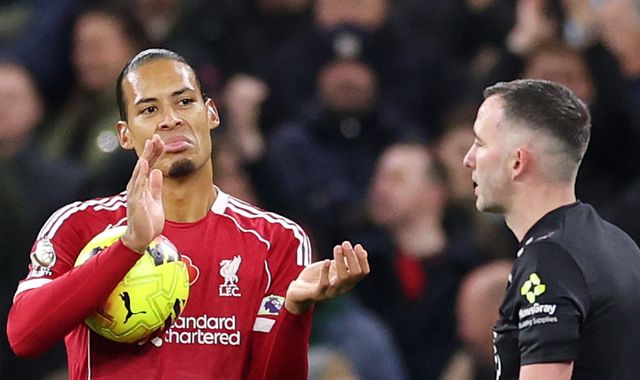
VAR isn’t about perfection.
As much as we'd like it to be, VAR is actually about checking the validity of a referee's on-field decision. And - as Howard Webb, the head of referees, made clear in August - there has been a subtle move this season to give still further priority to the on-field decision. The VAR has been told only to intervene if there is a "clear and obvious error". If it is a subjective decision, or one which is marginal, the VAR will stick with the referee's call, and keep quiet.
Inevitably, that means the VAR might not 100 per cent agree with the on-field referee's decision, but if that decision doesn't reach the threshold of "a clear and obvious error", they will not intervene. The idea is to give the referee primacy, and limit the number of interruptions to play.
- Live Premier League table | Watch PL highlights for free
- Got Sky? Watch PL games LIVE on your phone?
- No Sky? Get Sky Sports or stream with no contract on NOW?
This is where the PGMO, in its oversight of the Premier League, takes a different approach to FIFA, who is considering extending the scope of VAR's involvement in next summer's World Cup to include corner kicks.
Which would fans prefer?
There is understandable frustration - especially in the stands - when VAR reviews interrupt the flow of the game and quell the atmosphere. There is also frustration if refereeing mistakes are allowed to go uncorrected. Combining the two is a very difficult balancing act.
In the Premier League, one area of the game in particular has, this season, come in for greater scrutiny than ever before: when a goal is scored and an attacking team-mate is in an offside position. This feels like the most problematic area of refereeing right now, and has sparked plenty of debate.
Why is it so difficult? Because offside is an objective fact - a player is either offside or onside when a ball is played. But whether a player in an offside position is INTERFERING WITH AN OPPONENT is a subjective decision, and is left down to the referee's interpretation.
On every occasion the referee and VAR have to assess, on a sliding scale, whether the level of interference has passed a threshold where a goal should be disallowed.
The evidence...
On seven different occasions in the past seven weeks, a 'goal' has been scored with an attacking player in an offside position. Only two of those seven occasions saw the referee's original decision changed after intervention from the VAR. That emphasises how match officials are heeding the direction of their boss - to only intervene if there is a serious mistake.
The Key Match Incident Panel which looked at the controversial disallowing of Virgil van Dijk's goal against Manchester City last month decided the goal should have stood, but that the VAR was right not to intervene because it wasn't a clear and obvious error.
Because none of the other seven goals we are focusing on here have been highlighted by the PGMO or clubs involved, it is a safe assumption that all of the seven incidents under the KMI Panel microscope were deemed to have been dealt with correctly.
Remember, those five-person panels are made up of former players and managers, with one representative each from the PGMO and Premier League. And remember their decisions are nuanced, because in accepting that many refereeing decisions are subjective and marginal, the panel will not say they are wrong unless they are clearly and obviously incorrect.
So, if the people who are in-the-know have decided the officials didn't get any of these calls wrong, why are they so controversial with fans? And how can Liverpool fans in particular accept that, in the space of 14 days, they saw Van Dijk's header ruled out when it was deemed Andy Robertson was offside and interfering, only for Murillo's goal for Nottingham Forest against Liverpool to stand, when Dan Ndoye was offside and was close to Alisson's line of sight?
The answers to those questions are complex, but important.
The System...
For a start, each incident is viewed by the officials in isolation. Referees do a lot of work to make sure they are not influenced by any outside source, any previous decisions they have made in a game, or any previous incidents they may have seen or dealt with personally, when making a new decision. And no incident is ever exactly the same - how can it be?
In the case of those two Liverpool 'goals' (one for, one against) it is clear that Robertson is directly in line with Gianluigi Donnarumma, and that the Liverpool defender ducks when Van Dijk's header is goal-bound. That is a conscious move. And so when the goal was disallowed on the pitch, there was no reason for the VAR to intervene. It would be impossible to argue that the referee had made a clear and obvious error.
In the case of Murillo's goal, where Ndoye was in an offside position, of course there are similarities with the goal Liverpool saw chalked off against City. But crucially, the major difference is that Alisson had a clear line of sight when the Forest defender struck the ball - Ndoye was a few feet to his right. If the match referee had come to a different interpretation, and disallowed that goal, would it have been overturned by the VAR? Impossible to say. But probably not.
It almost certainly comes under that category which says whichever way the referee had gone - goal or no goal - the VAR wouldn't have intervened. That may sound unsatisfactory to a lot of fans and pundits, who would like there to be more black-and-white, more definite criteria to decide if an attacking player is interfering. But that is not the system we have, which in these cases are necessarily subjective.
The Trevoh Chalobah goal against Arsenal is another controversial incident worthy of analysis. Sky Sports News uncovered a new angle, not broadcast in the live match coverage, which showed Enzo Fernandez was in an offside position when Chalobah flicked the ball goalwards. So, was Enzo interfering with Cristhian Mosquera as the goal went in? Many will feel that he was. There is no doubt that opinion has justification.
But so does the opinion that Enzo didn't SUFFICIENTLY IMPACT the Arsenal defender to prevent him getting to the ball. Again - it is a subjective call, and it has been made clear to me that the VAR did see a replay of the incident, but he felt that the referee's call was one which could be legitimately held, and so again he didn't intervene. Webb can have no complaint about how his officials covered the incident. The protocols were followed correctly, and there was no clear and obvious error - despite many feeling the wrong decision was reached in a marginal call.
The mantra remains - if a goal is given on the pitch, there has to be a really compelling reason for the VAR to get involved and tell the referee they have got it clearly wrong.
Is there a different way?
Imagine if IFAB, the independent body which determines the laws of the game, or the PGMO tried to be more definite in defining exactly when a goal should be chalked off for an attacking player being in an offside position. It would make it clear cut if the rules said, for example, that all goals should be ruled out if an attacking player is in an offside position centrally, within the distance between the two goal posts.
But is that what football wants? A 25-yard screamer chalked off because a player was offside a few yards ahead of the scorer, in the line of the goal?
Maybe instead a rule could be introduced that says no goal should stand if an attacking player is offside in the six-yard box. But what then about a player offside in the far corner of the six-yard area, nowhere near the ball when his team-mate scores from close range in the centre of the goal?
There is no perfect solution. There is no single rule that can be introduced to cover all eventualities in this instance. And so we are stuck with the system that we have, and which PGMO is trying to enforce. A subjective system, where the match officials will decide if a goal should stand or not, based on their judgement about whether an offside player is interfering.
At least now, with VAR, the final decision is based on a committee view - with the referee, referee's assistants, and the VAR all involved before a final decision is made.
VAR is not a perfect system. It can never be so.
Mistakes will be made. Differences of opinion will prevail when it comes to marginal judgement calls. But such is the game of football, which has been dominated by debate and opinion ever since it became professional in 1885.
Plenty of people thought, when it was introduced, VAR would mark an end to controversy and be a "golden-bullet" for correct decisions. It is not, and never will be, that.
(c) Sky Sports 2025: Is intefering with play the most difficult area of refereeing right now? - The Whistle Blower
 The Ashes: Ollie Pope's 'chaotic' innings set tone for England latest batting failure in Adelaide, says Nasser Hussain
 The Ashes: England slide towards series defeat as batting fails again to give Australia control of third Test in Adelaide
 Women's Champions League draw: Arsenal to face OH Leuven in play-off with Chelsea awaiting winner as Man Utd play Atletico Madrid
 Scorecard: Australia vs England, third Ashes Test, Adelaide