

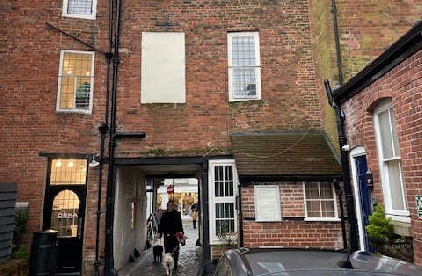
A proposal to provide residential accommodation at a Ludlow shop and cafe has been refused.
OSKA Ludlow Ltd submitted a planning application for a premises in Castle Street.
The applicant’s agent, John Walton, proposed an entrance lobby on the ground floor, a kitchenette and shower room on the first floor, and a bedroom and living room on the second floor.
The existing cellar would have remained untouched, added Mr Walton, and the loft space would have been locked and used only for occasional essential maintenance.
“The work will have a minor effect on the external appearance and will not alter the setting,” said Mr Walton.
“There will be no need to remove the existing lath and plaster faced partition on the second floor as originally intended in the pre-application process.
“It is proposed to provide insulation to the internal face of external walls to improve the energy performance of the proposed habitable areas.
“The insulation will be contained in new free-standing walls separate from the
existing plastered masonry walls.
“There is no visible evidence of original timber-framing in the existing external walls, apart from the wall bounding the passageway from Castle Street to Quality Square, all of which is unaffected by these proposals and outside the scope of the work.
“It is considered that the installation of the cowls will have very little impact on the overall appearance of the building, especially as no cowls will be
affixed to the front elevation and their size will be such that they will not have an intrusive presence.”
Mr Walton added that there was no intention to alter the existing landscaping, and access to the property wouldn’t be altered.
Tabitha Lythe, planning and development services manager at Shropshire Council, said the proposal failed to provide sufficient information to enable the local planning authority to fully assess the impact of the works.
“The submitted heritage statement is notably brief and does not offer a proportionate or meaningful assessment of the building’s significance, its surviving historic fabric, or the contribution of its historic plan form to that significance,” she said.
“Furthermore, the introduction of new subdivisions and internal linings to facilitate residential use has not been robustly justified and raises concern regarding the potential loss or obscuring of historic fabric, the erosion of the building’s legible plan form, and possible risks to the moisture management performance of the historic structure.”
Ms Lythe said it was recognised that the proposal would have created a new dwelling well located to access local services and facilities but that this did not amount to a “significant public benefit that would outweigh the harm arising from the proposed alterations”.
 Council confirms final budget proposals following public consultation
 Plans for holdiday accomodation on bus
 Changes to number of EV chargers at Magor Services