
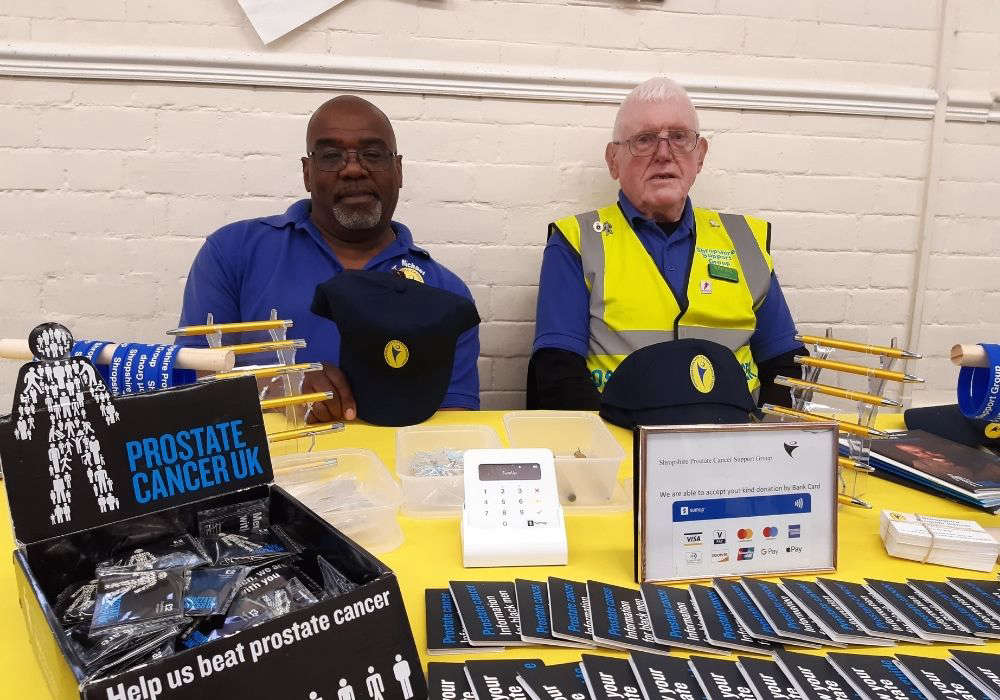
The Shropshire Prostate Cancer Support Group, based in Oakengates, makes it clear that the PSA protein-in-the-blood test is not a fool-proof way of diagnosing prostate cancer.
My trepidation around needles paled into almost insignificance when I attended a council-supported blood testing event in Telford.
The stories of male lives cut short by prostate cancer – including a gent who devastatingly died within a few weeks of his 50th wedding anniversary – certainly makes one reflect.
The Shropshire Prostate Cancer Support Group, based in Oakengates, makes it clear that the PSA protein-in-the-blood test is not a fool-proof way of diagnosing prostate cancer.
Indeed, three quarters of men who record a raised PSA (Prostate Specific Antigen) test do not have the disease and can end up being unnecessarily worried.
But volunteers insist it is the best we have got in the absence of universal screening and if it saves one life it is worth it. Men over 50 are entitled to discuss the option of having a free PSA test with their GP.
Prostate cancer survivor Dennis Briggs is an ex-soldier who was first alerted to a potential problem when he couldn’t go to the toilet while attending a reunion event in Lichfield. Eighteen months later he was found to have cancer which was successfully treated.
Appalled by the lack of information he and four other men set up the county group 25 years ago. Mr Briggs has been organising local PSA testing events over the last 12 years and was delighted to see 272 men listed to get their blood tested at Lawley Community Centre on Monday evening.
“I think it’s brilliant,” said Mr Briggs. “A lot of work goes on to set them up but we have very few problems.”
Each event costs upwards of £6,000 to organise but for the last three years Lawley and Overdale Parish Council has match funded the events. This year’s contribution is £3,500 of public funds was a good use of funds, the council says.
Parish council chairman Mark Boylan said it is a commitment the authority sees as important.
“It is the most common cancer in men,” said Councillor Boylan. “There are 64,000 annual diagnoses and 12,000 deaths so it’s very important including in Telford.
“It gives an opportunity for people who never go to the doctor to come and get tested.
“I get tested every year,” the councillor added. “My father comes too and we get booked out within weeks. It is open to men over the age of 40.
“For one in 300 men having the test turns out to be a life saver so it does impact lives and this event helps us highlight men’s health in an ageing part of Telford.”
Monday evening’s event was packed with men, some of whom were chivvied along by their wives. Some of the chaps I spoke to were there because of a family history of prostate cancer.
Indeed, one of the reasons behind me attending was through hearing the experiences of Dave Ricketts, the chairman of the Shrewsbury and West Shropshire branch of the Campaign for Real Ale (CAMRA).
Mr Ricketts was found to have stage three prostate cancer in a GP-sanctioned official test.
“I was told that I was within a month of it becoming terminal,” said Mr Ricketts. “I would advise anyone to speak to their GP about having a test.” He is now feeling “much better”.
Julie Rich, from Newport, organises the group of volunteer trained health professionals who take blood and package it up for lab testing.
She’s done this for around 14 years and is “passionate” for a very personal reason about promoting events including those organised by Lions Clubs.
“I lost my father Ronald Evans 20 years ago to prostate cancer,” she said. “I saw the effect that the disease had on reducing a big man to just five and a half stones before he died.
“He was 72 and died just two and a half weeks before his golden wedding anniversary,” she said.
Since then she has been “passionate” about promoting PSA testing events.
“The recent decision to not have universal testing is absolute rubbish,” she said.
Men who receive abnormal test results are advised by the support group to badger their GPs to see them for an official assessment.
The Graham Fulford Charitable Trust, which is behind the local support group’s events, says a raised level of PSA “should prompt further investigation by your GP.”
Given courage by the stories I heard, I sat with a worried look on my face in front of blood tester Emma Wright but looked away as the syringe approached my outstretched left arm.
There’s not much to it after all. It is all over in less than a minute as the vial is labelled up for sending off for testing in a laboratory.
Staff are on hand for the occasional fainters – including burly lads who crumple at the sight of needles so there’s no need to worry if that happens.
How I will feel if I receive a letter up to three three weeks from now telling me I have a raised antigen level I don’t know. Official advice is not to panic.
To find a public PSA testing event near you, visit https://www.mypsatests.org.uk/
