
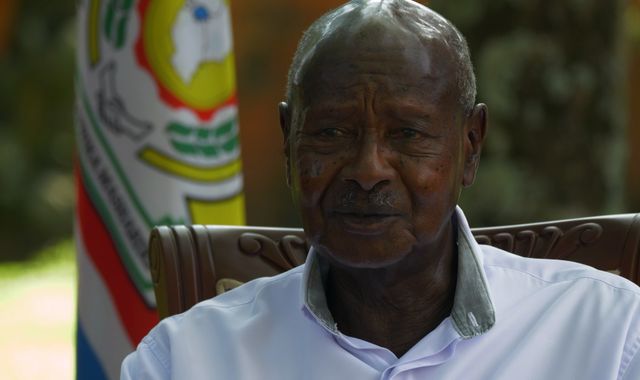
A church service at Nakasero State House marks the end of a frenetic election cycle.
The congregation sings "Guide Me Oh Thou Great Redeemer" as they wait for the arrival of their long-time leader and one of the longest-serving in Africa, President Yoweri Museveni.
A nation-wide internet shutdown has turned Kampala into a muted capital, and the oasis of the State House compound feels even more hushed and isolated above the traffic.
A period of intense political campaigning has been marred by the mass arrests of activists and opposition supporters is now ending in the suspension of nine local human rights organisations and an enforced digital silence.
"We are the ones who built the internet. The shutting down is about dealing with criminals who want to use that infrastructure to destabilise our country," President Museveni tells me in the manicured gardens of State Lodge behind the Chapel.
"It is temporary, short term - but we are the ones who built it. "
Does building it mean you can shut it down?
"No, it's like a road closure."
We travelled to Kampala to speak to the 81-year-old President as Ugandans cast their ballots in what will be his seventh successive election.
He is seeking to add another five years to his four decades in power. In 2005, Uganda's parliament passed a controversial constitutional amendment to lift the two term limit and the age limit of 75 was lifted in 2018.
"If I am available - not dead, not senile but I am still around - and I have some knowledge. If you are really serious about your country why would you not want to take advantage of me if I am still able?" he asks.
This month marks forty years since President Museveni secured victory in the Bush War as a rebel leader in January 1986 and ascended to power.
He was protesting the allegedly rigged election of former Prime Minister Milton Obote when he launched the five year battle for "fundamental change".
Read more from Sky News:
Is America surrendering Antarctica to its rivals?
Iranian woman who fled Tehran describes killings
Does his younger self connect with the need for change that many young people in Uganda are expressing?
"I was actually dying to work with old people because we needed them, unless you are not serious. These problems are big problems and if you are with a big problem, the more hands the better," says the President.
"I was working with [Julius] Nyerere of Tanzania and with Mandela. They were older people but we needed them. I couldn't say go away because I needed to be the one in charge."
A majority of Uganda's population were not alive to witness the Bush War and affirm its necessity. More than 70% of Ugandans are under the age of 30 and the country has one of the lowest median ages in the world at only 17 years old.
President Museveni says his party offers jobs for young people and economic growth for the country. When I asked what the future of Uganda looks like to a man who has seen it all, his answer was quick: "prosperity".
Economic growth is at the top of the list of wins that President Museveni says are the gains referred to in his campaign slogan "protecting the gains": "the economy [the GDP] is almost at $70 billion. When we started it was at $3.9 billion."
But youth unemployment is still high and masses of young Ugandans are currently calling for change by rallying behind 43 year old musician turned opposition leader Bobi Wine.
Bobi Wine has been aggressively targeted by the security apparatus since 2018. Scores of his supporters were killed and arrested by security forces in the 2021 election cycle - Uganda's most violent election to date.
This time, Wine's political party claims that 300 of their supporters and party officials have been arrested by the authorities in the lead-up to the ballot.
What is Museveni's reasoning behind his government's targeting of Bobi Wine?
"Bobi Wine breaks the law, that is why. There are other people in opposition - you don't find us having problems with them. But if you take each case, you find that he is breaking the law."
Museveni's traditional opposition opponent, his military doctor in the Bush War, Kizza Bisegye is currently in prison facing treason charges.
After weathering different eras and global partnerships, he is now witnessing the potential collapse of the Western alliance.
President Museveni said he hasn't spoken to Donald Trump but "unlike Biden" he doesn't force homosexuals on Uganda - as part of a lengthy rant against the "deviance" of the LGBTQI+ community.
President Museveni's former comrades, including the third leading presidential candidate Major General Mugusha Muntu, are critical of the President for holding onto power for so long.
In his speeches and writings from forty years ago, Museveni argues that Africa's problems lie in leaders overstaying in power instead of handing it back to the people. What changed?
"We gave power to the people long ago. They are the ones who elected me. They have been in charge all of this time and I am here because they say "you stay".
But as we speak about allegations of consistent election rigging, violent crackdowns and a monopoly on power, his stance is clear:
"You need to concentrate on what is being done, not who - you think this is a theatre? Just changing the people?"

(c) Sky News 2026: 'It's like a road closure' - Uganda's president on shutting down the internet as his
 Murder investigation launched after 68-year-old woman stabbed to death in village
 Sadiq Khan: AI could usher in new era of mass unemployment
 Yellow weather warning for rain extended - with flooding expected in parts of England
 I'm ashamed of Sir Keir Starmer, says rebel MP - as row over justice reforms escalates