

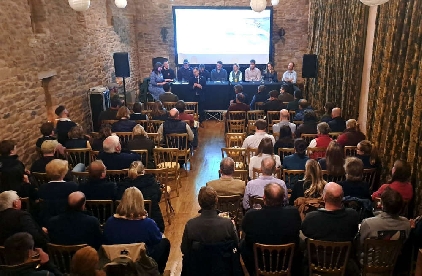
More environmentally friendly farming can make good business sense in challenging times, farmers heard at a recent event organised by Herefordshire Rural Hub.
Its managing director and chair for the evening Kate Speke-Adams asked a panel of “home” and “away” farmers whether sustainable farming meant “sharing”, that is, combining nature with food production, or “sparing” – taking land out of production.
“It’s nonsense to say, ‘farm the hell out of one area and leave the rest alone’,” Rich Thomas, a mixed farmer from Risbury near Leominster, said.
“Land sharing is working with nature, and we should do it more.”
Shropshire mixed farm manager and founder of the Green Farm Collective Michael Kavanagh said: “We are doing good things already, proving that food production and nature recovery can work side by side.”
At his home farm, “we have increased soil organic matter by 0.75 per cent in six years, my costs are down and wheat yields are up to 10 tonnes a hectare”, he said – compared with a recently acquired, unimproved farm where yields are barely half that.
“It’s easy to justify. The challenge is how to speed up that transition,” he said, adding that support under agri-environment schemes for companion cropping and not using insecticides “was music to our ears as we are doing it anyway – but support takes the risk out of it”.
“It’s soil biology you need, and we have taken it out,” according to Northumberland mixed farmer Stuart Johnson, named soil farmer of the year 2023, who added this can be measured just as soil nutrients can.
To which Mr Kavanagh pointed out that “85-90 per cent of plant nutrients are microbe-mediated”.
Warwickshire sheep farmer Emily Padfield said the government’s sustainable farming incentive (SFI) “has opened the floodgates for farmers to embrace cover cropping”, and that such moves “can help farming get more buy-in from the public”.
Meanwhile the recent Budget announcements impacting on farming “have put cat among the pigeons”, Ms Speke-Adams said.
Ben Drummond, manager of Herefordshire farming business EC Drummond, said the government’s plans on business relief from inheritance tax were “an attack on enterprise as a whole”, while Rich Thomas called the measures “a blunt instrument, prompted by the politics of envy”.
Stuart Johnson warned that “one person’s crisis is another’s opportunity” and that more land would now be bought up by non-farmers.
 Ludlow Town Council told to fund parking order
 Eight-figure sum quoted to fix Ledbury station access
 Pothole chaos on Shropshire’s rural roads
 Shropshire Council wants to link up with Telford and Wrekin
 72 roads to be treated across Shropshire
 Shropshire NHS called to act over cause of ‘twice as many deaths as breast cancer’
 Pegasus FC cruise to huge win over Worcester Raiders in the Uhlsport Hellenic League Marsh Challenge Cup Semi Final
 More than 550 new EV charging points coming