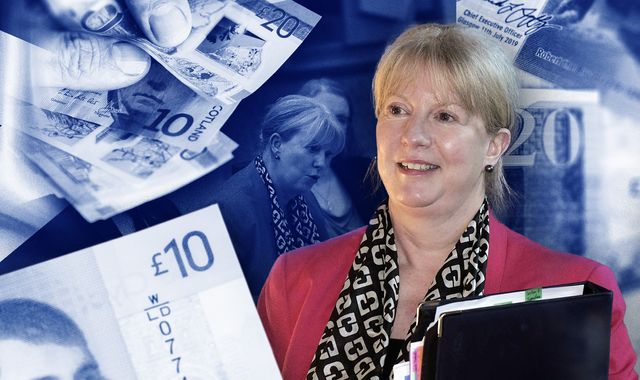
The Scottish government has unveiled its draft budget for 2026-27 - with a boost to its child payment benefit, changes to income tax and new taxes on expensive homes and private jet travel.
Finance Secretary Shona Robison says the SNP administration's spending plans would benefit families and was a budget for a "more prosperous Scotland".
It comes just four months before the Holyrood election, so some of the pledged changes are dependent on the party retaining power.
THE WINNERS
Scottish Child Payment
The Scottish Child Payment will be increased to £40 per week for families with a child under the age of one.
The change is scheduled come into force at the beginning of the 2027-28 year. It is currently £27.15 per week.
The benefit, which is given to low-income families, will also increase in line with inflation.
Ms Robison said: "The first year of a baby's life is one of the most exciting times for any family, but we know this time can bring extra stress and costs too.
"This support for mums and dads will help them through that critical first year of their child's life, delivering the best start in life for children and for families."
Breakfast clubs
The government has pledged funding to set up breakfast clubs in every primary and additional support needs (ASN) school by August 2027.
Ms Robison said it would give parents the opportunity to drop their children off at school earlier, which could open up new shifts at work.
She added: "For some, families saving on the cost of breakfast. For others, the kids getting a breakfast that they wouldn't otherwise receive, fuelling them to learn."
WINNERS AND LOSERS
Income tax
A tax cut has been provided to low earners.
Thresholds for the basic (20%) and intermediate rates (21%) will increase by 7.4% to £16,537 and £29,526 respectively.
This will push some workers into lower tax brackets and keep others from paying more.
The rise is expected to cost the government £50m in the coming financial year, according to the Scottish Fiscal Commission, while the decision to continue the freeze for other bands up to 2028-29 will see a £200m boost in that year.
The increase to the rates means the Scottish government can continue to claim that the majority of Scots pay less tax than they would elsewhere in the UK, a claim which has been debunked by experts in recent years.
Ms Robison later admitted lower earners would not save a "great deal of tax" due to the budget. But she said the package of support, including tax and social security, was worth about £480 a year.
Meanwhile, in 2025-26 there were 728,000 taxpayers in the higher, advanced and top bands. The Scottish government now expects that to increase to 834,000 in 2026-27.
Ms Robison said it would have cost £125m alone to increase the threshold for the 42p higher rate of income tax from its current level of £43,663 to £44,000.
In response, the Scottish Conservatives said the SNP was "clobbering middle-income workers".
MSP Craig Hoy, the Tories' shadow finance secretary, said: "Tens of thousands more nurses, teachers and police officers on relatively modest salaries are being dragged into the higher rate, which was never intended for them.
"The SNP's vindictive tax on aspiration is stifling Scotland's economic performance by making it harder and harder for businesses to recruit and retain skilled individuals."
Mr Hoy branded it a "bad budget for Scotland".
He added: "If you are earning £43,000 a year and you get a £2,000 pay increase next year, the Scottish government will take £1,000 of that.
"That's not fair, it's not equitable, and that is why the Scottish government is not growing the Scottish economy."
Read more from Sky News:
More than 500 pubs tipped to close this year
Out of a job and on benefits: Why Britain isn't working
THE LOSERS
Mansion tax
Two new council tax bands are to be created by April 2028 for homes worth more than £1m.
Band I will be for properties valued between £1m and £2m, while Band J will be for properties valued above £2m.
The higher bands seek to "improve fairness at the top end of the system" and will be based on up-to-date values for those properties only.
The Scottish government's budget document reads: "This is a targeted change, with fewer than 1% of households affected, and seeks to ensure that those with the broadest shoulders contribute more, by requiring the highest value properties to pay higher charges."
Ms Robison said the change will "bring greater fairness, as well as increased revenues to councils".
The wider council tax framework will remain unchanged.
Councils are to receive a record allocation of almost £15.7bn to deliver key public services.
Ms Robison said the funding to local government had risen by 2% in real terms and urged councils not to make large increases in levies.
She said: "Decisions on council tax rates will, of course, be taken locally.
"However, this is a reasonable deal and given the cost of living pressures that we all recognise, I urge local authorities to translate the settlement into reasonable decisions on council tax."
Private jet tax and air travel
An airport departure tax will be implemented by April 2027, with a consultation on a potential exemption for the Highlands and Islands.
The budget document says: "To provide certainty and stability for industry and taxpayers, we will match the UK government's APD rates and bands for 2027-28.
"Rates and bands for 2028-29 will be set out in the 2027-28 Scottish budget and developed in line with the Scottish government's high-level principles for ADT."
A tax for private jets is expected to come into force at some point after April next year.
Ms Robison said: "To those who choose to travel by private jet, in Scotland you will pay, and pay a fair share for that privilege, and in doing so you will be helping us make Scotland a fairer nation we all know it can and should be."

(c) Sky News 2026: The winners and losers in the Scottish budget
 UK 'won't back down' in row with Elon Musk's X over Grok sex images, says PM
 Bobi Wine: Uganda's pop star politician aiming to end president's 40 years in power
 Families of Nottingham attack victims fear 'further disasters' are 'inevitable' after CQC report into killer Valdo Calocane
 Black cab rapist John Worboys to face public parole hearing
